Professor McCloose
The prequel and La macchina ("The Machine"): the scientist who in 1868 tries to stop time by speeding up his own vital rhythms (in Italian).
Two short comics, three songs and a lot of theory
Professor John McCloose, distinguished lecturer at Hempshire University, is my first attempt to give shape to an idea that has always been with me: rhythms. The rhythm of footsteps, of the heart, of breathing, of a conversation. His story is made of two short comics and three songs: Una folle idea ("A mad idea") and Viaggio nelle sincronie ("Journey through synchronies") by Samsara, and La polvere ("Dust").
The story
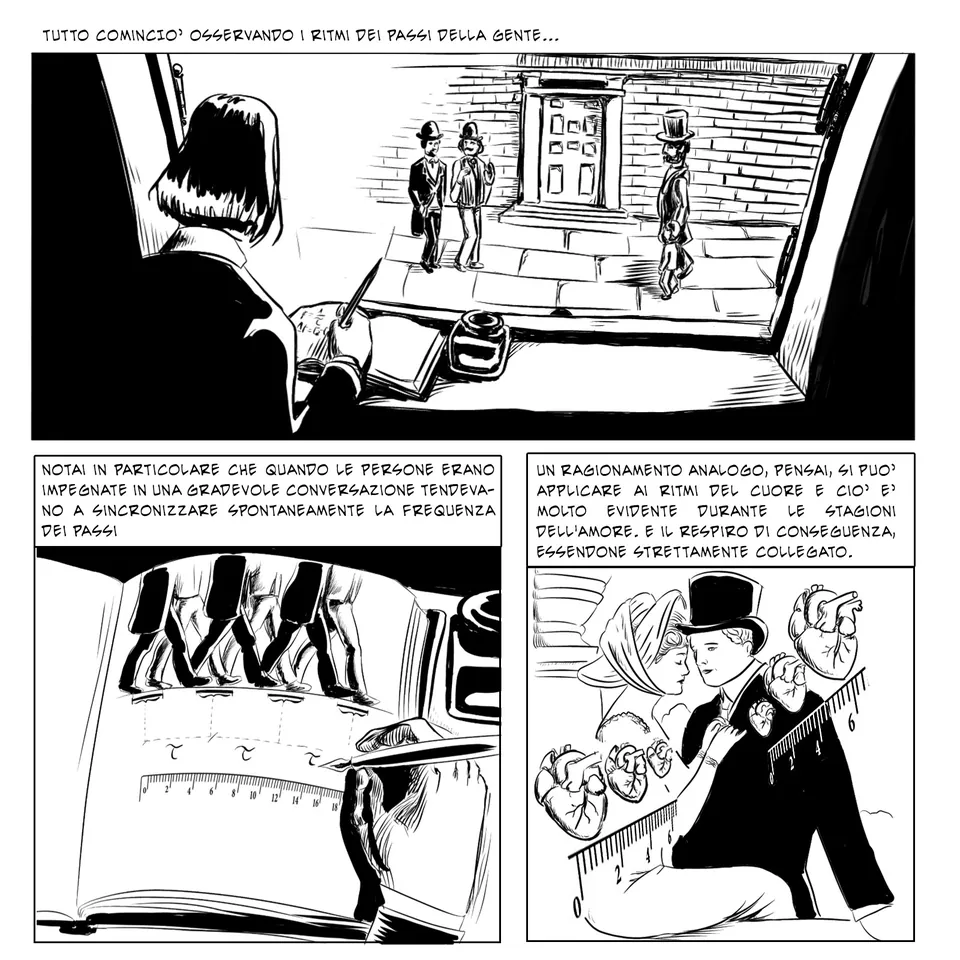
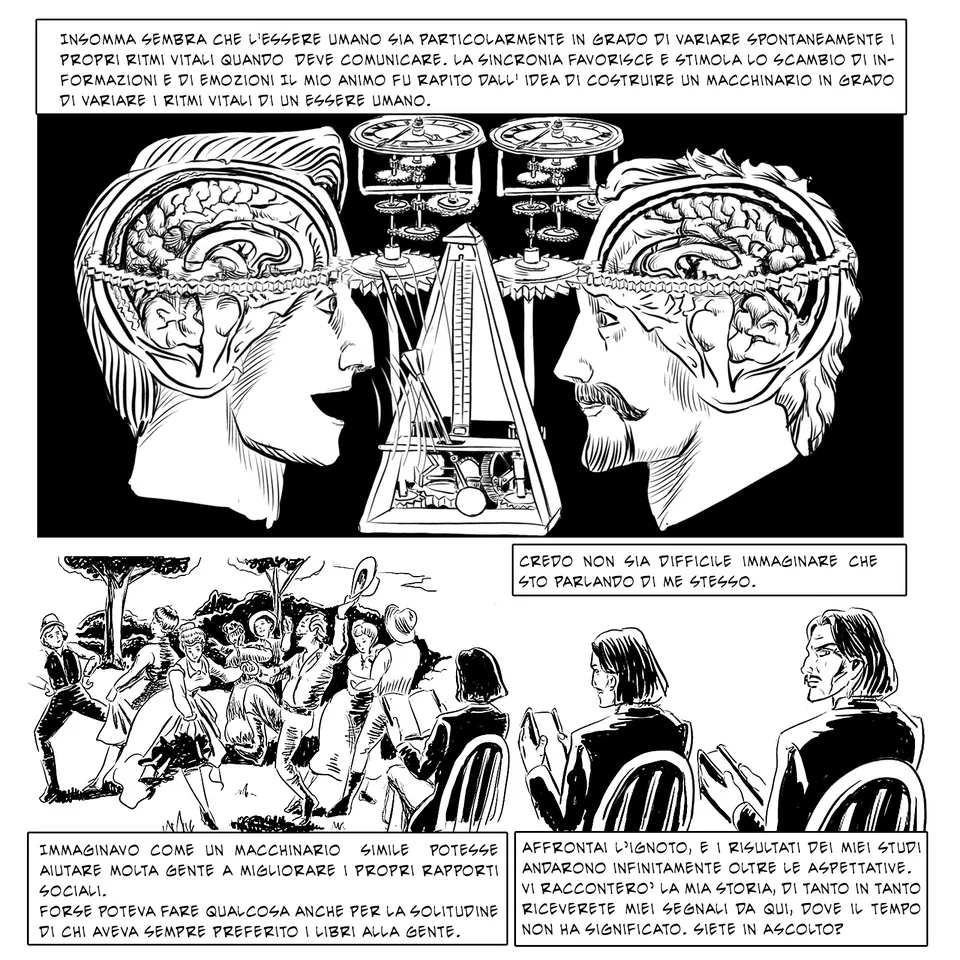
It all begins by watching people's footsteps: two people enjoying a pleasant conversation tend to fall into step, and the same happens to their heartbeat and breathing. McCloose becomes convinced that human beings spontaneously change their vital rhythms when they need to communicate, and he designs a machine able to vary them. It could help many people relate to others, and perhaps even ease the loneliness of those who always preferred books to people.
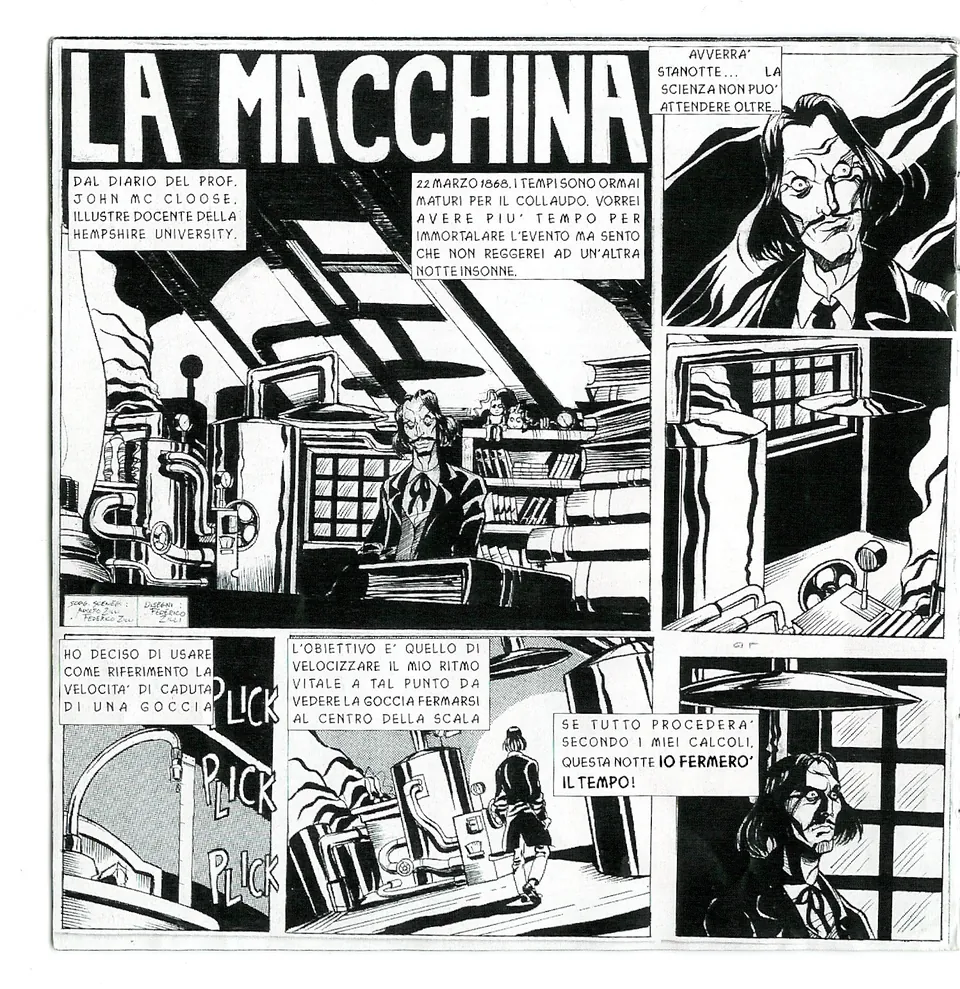
On 22 March 1868, in the attic of his laboratory, he switches it on: he wants to speed up his own vital rhythm until he sees a drop of water stop in mid-fall. "Tonight I will stop time." But the more time slows down, the more the room loses its light. And when he looks out over the city he finds that everyone is surrounded by a strange halo, each one different: thin, thick, shining, dark. Shaken, he abandons the laboratory for good and leaves his diary as the only record.
For thirteen years he leads a regular life. Then, from 14 October 1881, nothing more is heard of him: that day, at 11:04, his mother, his grocer and an entire university lecture hall see him appear and disappear, at the same moment, in different places.
The pages
La macchina ("The Machine"; story and script by Adolfo and Federico Zilli, drawings by Federico Zilli) came out together with the song lyrics of Imaginaria; the prequel tells how it all began. Click a page to see it full size (in Italian).


The theory
Behind the professor there is a question: why are some instants eternal and some hours over in a flash? Perhaps because in certain instants we perceive reality at a higher frequency, more times per second. Every rhythm, talking, walking, drawing, is a form of communication, and to understand them all you have to speed up the rhythm of your own perceptions. Just as McCloose does with his machine.
The halos in the comic have an explanation too. When something interests us, its image is printed on the retina more times per second and adds up with those of the previous instants; the tiny movements of the eyes shift it and create a kind of cloud around what we are looking at. It is a measure of interest, of quality, which lies neither in the observer nor in the observed but in the relationship between the two: an idea Robert Pirsig explores in Zen and the Art of Motorcycle Maintenance.
And the conclusion: communication is a transfer of energy, energy is a wave, a wave has a frequency, a frequency is a rhythm. So communication is a rhythm. When the wave has no frequency, when it is random, nothing gets through: it is noise.
The professor has come back several times in my work: in Assioma 5 to talk about energy, and in Pulboz (Theatre) to talk about reincarnation.
The songs
Una folle idea and Viaggio nelle sincronie close Samsara's Imaginaria (1997). In the first, the professor goes back to the attic and finds "latent energies scattered in the name of an idea"; the second is the journey itself: "the rhythm speeds up, my perception slows down". La polvere picks up the thread: dust as colonies of life forms suspended in the air, thought forms that surround us and that we breathe, "consciousnesses that float".
The songs of Professor McCloose · 3 tracks
Have a project in mind?
I work as a freelancer with companies, research institutes, museums and schools, in Italy and remotely across Europe. Drop me a line or give me a call.